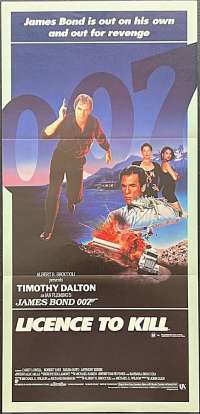
License To Kill Daybill Poster.Licence to Kill is a 1989 American-British spy film, the sixteenth in the James Bond film series produced by Eon Productions, and the last to star Timothy Dalton in the role of the fictional MI6 agent James Bond. It is the first one not to use the title of an Ian Fleming story. It is also the fifth and final consecutive Bond film to be directed by John Glen, also the last film to feature Robert Brown as M & Caroline Bliss as Miss Moneypenny, as well as the final film to have both the Gun barrel and title sequences designed by Maurice Binder. The story has elements of two Ian Fleming short stories and a novel, interwoven with aspects from Japanese Rōnin tales. The film sees Bond being suspended from MI6 as he pursues drug lord Franz Sanchez, who has ordered an attack against his CIA friend Felix Leiter and the murder of Felix's wife during their honeymoon. Originally titled Licence Revoked in line with the plot, the name was changed during post-production due to American test audiences associating the term with driving. The film earned over $156 million worldwide and enjoyed a generally positive critical reception with ample praise for the stunts.
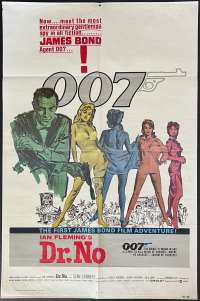
About this poster: This poster looks extremely similar to the first release poster from 1963 as it has the same Joseph Caroff & Mitchell Hooks artwork and it even has a 1962 copyright date on it.In 1980, United Artists re-released the early James Bond movies, and printed them from the same printing plates as the originals, but they can be easily distinguished from the originals because they are on a glossier paper stock, and also because they do not have the NSS information at the bottom right, but instead the title is in all capitals at the bottom righthand corner. This opportunity is perfect for any James Bond fan who loves the first release artwork but cannot afford nearly AU$3,000.00 for a first release edition.It is a Bond bargain!
Dr. No is a 1962 British spy film, starring Sean Connery, with Ursula Andress and Joseph Wiseman: it is the first James Bond film. Based on the 1958 novel of the same name by Ian Fleming, it was adapted by Richard Maibaum, Johanna Harwood, and Berkely Mather and was directed by Terence Young. The film was produced by Harry Saltzman and Albert R. Broccoli, a partnership that would continue until 1975.Dr. No also launched a genre of "secret agent" films that flourished in the 1960s. The film also spawned a spin-off comic book and soundtrack album as part of its promotion and marketing.
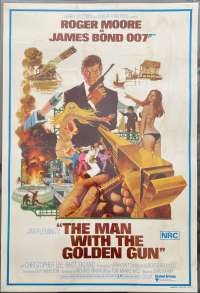
The Man With The Golden Gun Poster One Sheet Original Rolled Lamintaed 1974.Note: Please read the condition report before buying and noting it is a laminated original poster. This is an opportunity for the James Bond collector to pick up a poster at a budget price.
The Man with the Golden Gun is a 1974 spy film and the ninth in the James Bond series produced by Eon Productions, and the second to star Roger Moore as the fictional MI6 agent James Bond. A loose adaptation of Ian Fleming's novel of the same name, the film has Bond sent after the Solex Agitator, a device that can harness the power of the sun, while facing the assassin Francisco Scaramanga, the "Man with the Golden Gun". The action culminates in a duel between them that settles the fate of the Solex. The Man with the Golden Gun was the fourth and final film in the series directed by Guy Hamilton. The script was written by Richard Maibaum and Tom Mankiewicz. The film was set in the face of the 1973 energy crisis, a dominant theme in the script. Britain had still not yet fully overcome the crisis when the film was released in December 1974. The film also reflects the then popular martial arts film craze, with several kung fu scenes and a predominantly Asian location, being set and shot in Thailand, Hong Kong, and Macau. Part of the film is also set in Beirut, Lebanon, but it was not shot there. Christopher Lee's portrayal of Scaramanga as a villain of similar skill and ability to Bond was generally praised. It was the last film to be co-produced by Albert R. Broccoli and Harry Saltzman, with Saltzman selling his 50% stake in Danjaq, LLC, the parent company of Eon Productions, after the release of the film.
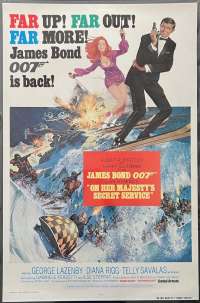
On Her Majesty's Secret Service One Sheet Poster 1980 USA Re-Issue.In 1980, United Artists re-released the early James Bond movies for screenings and printed a series of theatre posters from the same printing plates as the originals.Except for some small differences the artwork is exactly the same consequently.Due to this poster being laminated it is not worth what the re-issue would be but it is an opportunity for the Bond collector to pick up the cool artwork at an affordable price.
On Her Majesty's Secret Service is a 1969 spy film and the sixth in the James Bond series produced by Eon Productions. It is based on the 1963 novel of the same name by Ian Fleming. Following Sean Connery's decision to retire from the role after You Only Live Twice, Eon Productions selected an unknown actor and model, George Lazenby, to play the part of James Bond. Lazenby was offered a contract for seven films; however, he was convinced by his agent Ronan O'Rahilly that the secret agent would be archaic in the liberated 1970s, and as a result he left the series after the release of On Her Majesty's Secret Service in 1969. A decision that proved to be not quite right. It is the only Bond film to have been directed by Peter R. Hunt, who had served as a film editor and second unit director on previous films in the series. Hunt, along with producers Albert R. Broccoli and Harry Saltzman, decided to produce a more realistic film that would follow the novel closely. It was shot in Switzerland, England, and Portugal from October 1968 to May 1969. Although its cinema release was not as lucrative as its predecessor You Only Live Twice, On Her Majesty's Secret Service was still one of the top performing films of the year. Critical reviews upon release were mixed, but the film's reputation has improved greatly over time.
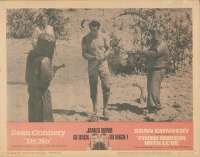
USA Lobby Card 8 Original 11x14. This 1965 Re-Issue is rarely seen and is a must have for the serious James Bond collector.
The 1965 double-bill release ("Double the danger! Double the women! Double the excitement with double Double-O-Seven!") of Ian Fleming's Dr. No and From Russia With Love.
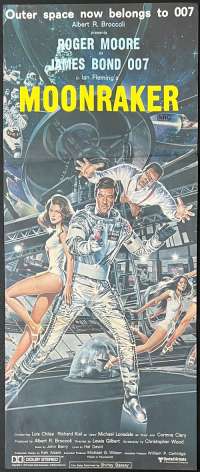
Rare Daybill Poster without borders (Full Bleed) with art by Daniel Goozee.Moonraker (1979) is the eleventh spy film in the James Bond series, and the fourth to star Roger Moore as the fictional MI6 agent James Bond. The third and final film in the series to be directed by Lewis Gilbert, it co-stars Lois Chiles, Michael Lonsdale, Corinne Cléry, and Richard Kiel. Moonraker was noted for its high production cost of $34 million, spending almost twice as much money as predecessor The Spy Who Loved Me, and it received very mixed reviews. However, the film's visuals were praised, with Derek Meddings being nominated for the Academy Award for Best Visual Effects, and the film eventually became the highest grossing film of the series with $210,300,000 worldwide,a record that stood until 1995's GoldenEye.
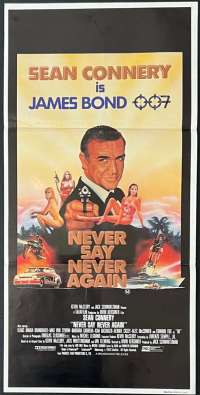
Rare Daybill Poster with striking artwork by Rudy Obrero.Never Say Never Again is a 1983 spy film based on the James Bond novel Thunderball, which was previously adapted in 1965 under that name. Unlike the majority of Bond films, Never Say Never Again was not produced by Eon Productions, but by an independent production company, one of whose members was Kevin McClory, one of the original writers of the Thunderball storyline with Ian Fleming and Jack Whittingham. McClory retained the filming rights of the novel following a long legal battle dating from the 1960s. The film was directed by Irvin Kershner and, like Thunderball, stars Sean Connery as British Secret Service agent James Bond, 007, marking his return to the role 12 years after Diamonds Are Forever. It is Connery's seventh outing and final performance as Bond in a feature film. Only Roger Moore equaled playing Bond this many times. This is the preferred poster artwork of collectors.
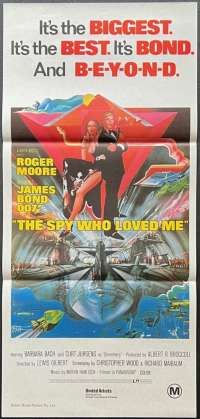
Daybill Poster with art by Bob Peak in rare near mint condition. The Spy Who Loved Me is a 1977 spy film and the tenth in the James Bond series produced by Eon Productions, and the third to star Roger Moore as the fictional secret agent James Bond. Barbara Bach and Curd Jürgens co-star. It was directed by Lewis Gilbert The film takes its title from Ian Fleming's novel The Spy Who Loved Me, the tenth book in the James Bond series, though it does not contain any elements of the novel's plot. The storyline involves a reclusive megalomaniac named Karl Stromberg, who plans to destroy the world and create a new civilisation under the sea. Bond teams up with a Russian agent, Anya Amasova, to stop Stromberg. It was shot on location in Egypt (Cairo and Luxor) and Italy (Costa Smeralda, Sardinia), with underwater scenes filmed at the Bahamas (Nassau), and a new soundstage built at Pinewood Studios for a massive set which depicted the interior of a supertanker. The Spy Who Loved Me was well-received by critics, who saw the film as a return to form for the franchise. The soundtrack composed by Marvin Hamlisch also met with success. The film was nominated for three Academy Awards amid many other nominations. It was Roger Moore's favourite Bond film and many reviewers consider it the best instalment to star the actor.
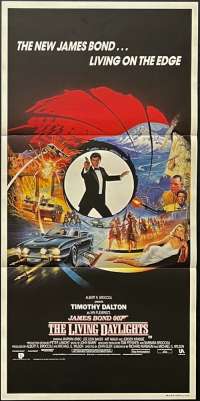
Daybill Poster with Brian Bysouth art in rare unused condition.The Living Daylights is a 1987 spy film and the fifteenth entry in the James Bond series produced by Eon Productions, and the first to star Timothy Dalton as the fictional MI6 agent James Bond. Directed by John Glen, the film's title is taken from Ian Fleming's short story "The Living Daylights", the plot of which also forms the basis of the first act of the film. It was the last film to use the title of an Ian Fleming story until the 2006 instalment Casino Royale. The film was produced by Albert R. Broccoli, his stepson Michael G. Wilson, and his daughter, Barbara Broccoli. The Living Daylights was generally well received by most critics and was also a financial success, grossing $191.2 million worldwide.
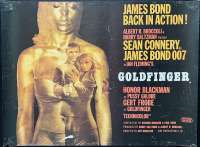
Goldfinger Poster UK Commercial 1980's Quad Reprint. Goldfinger featuring a gold-dipped Shirley Eaton superimposed over Bond (Sean Connery) with his weapon drawn and clutching Pussy Galore (Honor Blackman), this poster is a must for Bond collectors and perhaps one of the most desirable. Although not quite the same size as UK quads but with the same artwork. UK quads with this art have sold for nearly AU$8,000.00 in better condition.This is your chance to pick up the amazing artwork at a bargain! Check the condition report prior.
Goldfinger is a 1964 spy film and the third instalment in the James Bond series produced by Eon Productions, starring Sean Connery as the fictional MI6 agent James Bond. It is based on the 1959 novel of the same name by Ian Fleming. The film also stars Honor Blackman as Pussy Galore and Gert Fröbe as the title character Auric Goldfinger, along with Shirley Eaton as the ill-fated Jill Masterson. Goldfinger was produced by Albert R. Broccoli and Harry Saltzman and was the first of four Bond films directed by Guy Hamilton.
This poster in the same size and artwork will sell up to AU$100.00. They are in better condition but you can get a bargain here, note the condition report first.
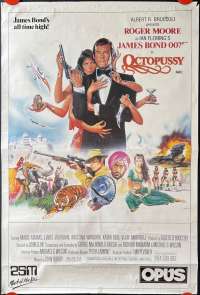
Rare Preview Radio 2SM Screening Folded Australian One Sheet Poster, a must have for any collector.Australian radio station 2SM had film promotion previews in the 1980s, and this rare poster is from a preview screening.Octopussy is a 1983 spy film and the thirteenth in the James Bond series produced by Eon Productions, and the sixth to star Roger Moore as the fictional MI6 agent James Bond. It was directed by John Glen. The film's title is taken from a short story in Ian Fleming's 1966 short story collection Octopussy and The Living Daylights, although the film's plot is original. It does, however, include a scene inspired by the Fleming short story "The Property of a Lady" (included in 1967 and later editions of Octopussy and The Living Daylights), while the events of the short story "Octopussy" form a part of the title character's background and are recounted by her. Bond is assigned the task of following a general who is stealing jewels and relics from the Soviet government. This leads him to a wealthy Afghan prince, Kamal Khan, and his associate, Octopussy, and the discovery of a plot to force disarmament in Western Europe with the use of a nuclear weapon. Octopussy was produced by Albert R. Broccoli and Michael G. Wilson, and was released in the same year as the non-Eon Bond film Never Say Never Again starring Sean Connery. The film earned $187.5 million against its $27.5 million budget. Critics praised it for the action sequences and locations. Maud Adams' performance was nominated for the Saturn Award for Best Supporting Actress and the film won the Golden Reel Award for Best Sound Editing.
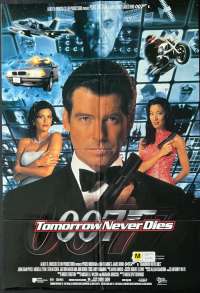
One Sheet Movie Poster double sided.This Australian one sheet was used in New Zealand for screening purposes and thus it has the NZ ratings snipe applied.Tomorrow Never Dies is a 1997 spy film and the 18th in the Bond series to be produced by Eon Productions, and the second to star Pierce Brosnan as the fictional MI6 agent James Bond. Directed by Roger Spottiswoode, with the screenplay written by Bruce Feirstein, the film follows Bond as he attempts to stop Elliot Carver, a power-mad media mogul, from engineering world events to initiate World War III. The film was produced by Michael G. Wilson and Barbara Broccoli, and was the first James Bond film made after the death of producer Albert R. Broccoli, to whom the film pays tribute in the end credits. Filming locations included France, Thailand, Germany, Mexico and the United Kingdom. The title was inspired by the Beatles' song "Tomorrow Never Knows".The eventual title came about by accident: one of the potential titles was Tomorrow Never Lies (referring to the Tomorrow newspaper in the plot) and this was faxed to MGM. But due to a typing error this became Tomorrow Never Dies, a title which MGM found so attractive that they insisted on using it. The title was the first not to have any relation to Fleming's life or work.Tomorrow Never Dies performed well at the box office, grossing over $333 million worldwide, becoming the 4th highest-grossing film of 1997 and earned a Golden Globe nomination.Its performance at the domestic box office surpassed that of its predecessor, GoldenEye.
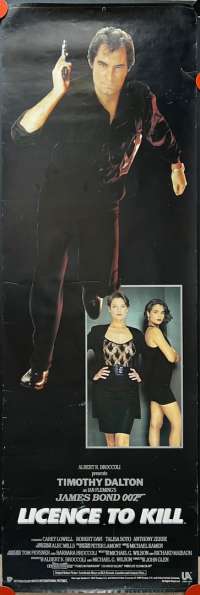
Note: Door panels of this same size and same artwork are selling for AU$200.00 or more and they are folded unlike this one which is rolled. They are in better condition but you can get a bargain here, note the condition report first.
License To Kill Door Panel original rolled. Licence to Kill is a 1989 American-British spy film, the sixteenth in the James Bond film series produced by Eon Productions, and the last to star Timothy Dalton in the role of the fictional MI6 agent James Bond. It is the first one not to use the title of an Ian Fleming story. It is also the fifth and final consecutive Bond film to be directed by John Glen, also the last film to feature Robert Brown as M & Caroline Bliss as Miss Moneypenny, as well as the final film to have both the Gun barrel and title sequences designed by Maurice Binder. The story has elements of two Ian Fleming short stories and a novel, interwoven with aspects from Japanese Rōnin tales. The film sees Bond being suspended from MI6 as he pursues drug lord Franz Sanchez, who has ordered an attack against his CIA friend Felix Leiter and the murder of Felix's wife during their honeymoon. Originally titled Licence Revoked in line with the plot, the name was changed during post-production due to American test audiences associating the term with driving. The film earned over $156 million worldwide and enjoyed a generally positive critical reception with ample praise for the stunts.
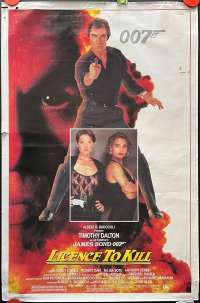
USA One Sheet original Poster.Note:Pick yourself up a bargain and note the condition report and additional image.No returns allowed on this item.
Licence to Kill is a 1989 American-British spy film, the sixteenth in the James Bond film series produced by Eon Productions, and the last to star Timothy Dalton in the role of the fictional MI6 agent James Bond. It is the first one not to use the title of an Ian Fleming story. It is also the fifth and final consecutive Bond film to be directed by John Glen, also the last film to feature Robert Brown as M & Caroline Bliss as Miss Moneypenny, as well as the final film to have both the Gun barrel and title sequences designed by Maurice Binder. The story has elements of two Ian Fleming short stories and a novel, interwoven with aspects from Japanese Rōnin tales. The film sees Bond being suspended from MI6 as he pursues drug lord Franz Sanchez, who has ordered an attack against his CIA friend Felix Leiter and the murder of Felix's wife during their honeymoon. Originally titled Licence Revoked in line with the plot, the name was changed during post-production due to American test audiences associating the term with driving. The film earned over $156 million worldwide and enjoyed a generally positive critical reception with ample praise for the stunts.
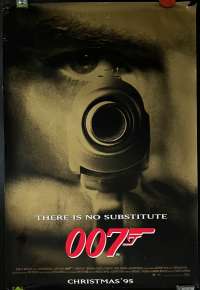
GoldenEye One sheet poster with advance teaser artwork.GoldenEye is a 1995 spy film. It is the seventeenth in the James Bond series produced by Eon Productions, and the first to star Pierce Brosnan as the fictional MI6 officer James Bond. It was directed by Martin Campbell and is the first in the series not to utilise any story elements from the works of novelist Ian Fleming. In the film, Bond fights to prevent an ex-MI6 agent, gone rogue, from using a satellite weapon against London to cause a global financial meltdown. The film was released after a six-year hiatus in the series caused by legal disputes, during which Timothy Dalton resigned from the role of James Bond and was replaced by Pierce Brosnan. M was also recast, with actress Judi Dench becoming the first woman to portray the character, replacing Robert Brown. The role of Miss Moneypenny was also recast, with Caroline Bliss being replaced by Samantha Bond; Desmond Llewelyn was the only actor to reprise his role, as Q. The film accumulated a worldwide gross of US$350.7 million and received positive reviews. It also received award nominations for "Best Achievement in Special Effects" and "Best Sound" from the British Academy of Film and Television Arts. The name "GoldenEye" pays homage to James Bond's creator, Ian Fleming. While working for British Naval Intelligence as a lieutenant commander, Fleming liaised with the Naval Intelligence Division to monitor developments in Spain after the Spanish Civil War in an operation codenamed Operation Goldeneye. Fleming used the name of this operation for his estate in Oracabessa, Jamaica.
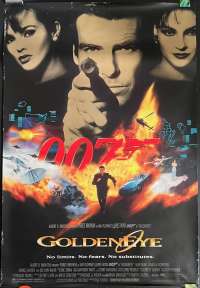
This original GoldenEye 1995 Double Sided rolled poster with different cast artwork is rarely seen. A must have for any serious James Bond collector.
GoldenEye is a 1995 spy film. It is the seventeenth in the James Bond series produced by Eon Productions, and the first to star Pierce Brosnan as the fictional MI6 officer James Bond. It was directed by Martin Campbell and is the first in the series not to utilise any story elements from the works of novelist Ian Fleming. In the film, Bond fights to prevent an ex-MI6 agent, gone rogue, from using a satellite weapon against London to cause a global financial meltdown. The film was released after a six-year hiatus in the series caused by legal disputes, during which Timothy Dalton resigned from the role of James Bond and was replaced by Pierce Brosnan. M was also recast, with actress Judi Dench becoming the first woman to portray the character, replacing Robert Brown. The role of Miss Moneypenny was also recast, with Caroline Bliss being replaced by Samantha Bond; Desmond Llewelyn was the only actor to reprise his role, as Q. The film accumulated a worldwide gross of US$350.7 million and received positive reviews. It also received award nominations for "Best Achievement in Special Effects" and "Best Sound" from the British Academy of Film and Television Arts. The name "GoldenEye" pays homage to James Bond's creator, Ian Fleming. While working for British Naval Intelligence as a lieutenant commander, Fleming liaised with the Naval Intelligence Division to monitor developments in Spain after the Spanish Civil War in an operation codenamed Operation Goldeneye. Fleming used the name of this operation for his estate in Oracabessa, Jamaica.
| PO Box 491 Sherwood, 4075, Brisbane Queensland, Australia |
|
| 0419 736 441 | |
| MON - FRI - 9am to 5pm | |
| This email address is being protected from spambots. You need JavaScript enabled to view it. |