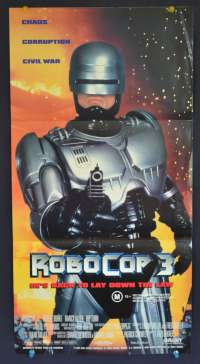
Daybill Poster.Robocop 3 is a 1993 American cyberpunk action film directed by Fred Dekker and written by Frank Miller and Dekker. Set in the near future in a dystopian metropolitan Detroit, Michigan, RoboCop 3 follows RoboCop (Robert John Burke) as he vows to avenge the death of his partner Anne Lewis (Nancy Allen) and tries to save Detroit from falling into chaos. It was filmed in Atlanta, Georgia. Most of the buildings seen in the film were slated for demolition to make way for facilities for the 1996 Olympics. Nancy Allen, Robert DoQui, Felton Perry, Mario Machado, and Angie Bolling are the only cast members to appear in all three films.
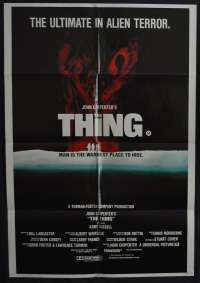
One Sheet Poster.The Thing 1982 Directed by John Carpenter and starring Kurt Russell. ‘The Thing’ when it was first released in the US bombed due to the success of E.T. and the competition of Bladerunner. It was not expected to do well in Australia consequently. Full colour one sheets like the one here of which only 500 – 1000 were printed by W & B Litho were released for the screening of the film in Australia. However the distributors were caught by surprise when the film took off in Australia and the film went on to screen for 3 months in cinemas – independent ones particularly. Consequently a re-issue was required to meet the demand of the screenings. This re-issue is the ‘all red’ artwork printed by M.A.P.S. The full colour First Release one sheet size above printed by W & B litho is very rare and highly collectible. Any collector that has the W & B Litho artwork daybill will want to have this rare one sheet first release companion piece.
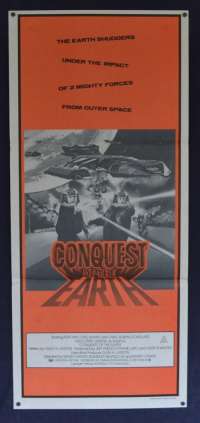
Original Daybill poster. Rare Red artwork .The continuing saga of the Battlestar Galactica - The Battlestar Galactica and its rag-tag fleet of ships finally arrive at the Earth, only to discover that the planet is not prepared for the inevitable Cylon invasion. The feature was released in cinemas in Europe, New Zealand and Australia only. It was made up of a number of TV episodes from the TV series Battlestar Galactica 80.
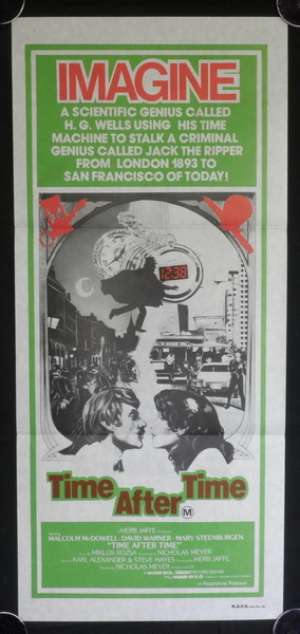
Daybill Poster.Time After Time is a 1979 American Metrocolor science fiction film directed by screenwriter Nicholas Meyer and starring Malcolm McDowell, David Warner, and Mary Steenburgen. According to David Warner, the studio wanted Mick Jagger for the role of John Leslie Stevenson (Warner’s role) but director Nicholas Meyer and producer Herb Jaffe fought for Warner to get the role. Time After Time was filmed throughout San Francisco. Filmed in Panavision, it was the directing debut of Meyer, whose screenplay is based on the premise from Karl Alexander's novel Time After Time (which was unfinished at the time) and a story by Alexander and Steve Hayes. The film presents a story in which British author H. G. Wells uses his time machine to pursue Jack the Ripper into the 20th century. The interior scenes set in London borrow heavily from the 1960 film, The Time Machine which was based on the 1895 H.G. Wells novella of the same name. The film premiered with a gala presentation at the Toronto International Film Festival on September 7, 1979. Time After Time received a positive response from critics. The cast and Director went on to win several awards.
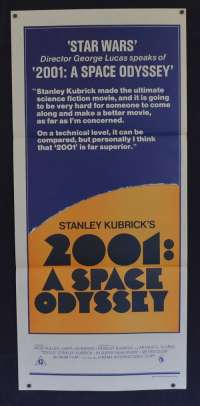
2001: A Space Odyssey Poster Stanley Kubrick Australian Daybill | 2001: A Space Odyssey is a science-fiction narrative, produced in 1968 as both a novel, written by Arthur C. Clarke, and a film, directed by Stanley Kubrick. 2001: A Space Odyssey is today thought by some critics to be one of the greatest films ever made and is widely regarded as the best science fiction film of all time. It was nominated for four Academy Awards, and received one for visual effects. It also won the Kansas City Film Critics Circle Best Director and Best Film awards of 1968. In 1991, 2001: A Space Odyssey was deemed culturally significant by the United States Library of Congress and selected for preservation in the National Film Registry.
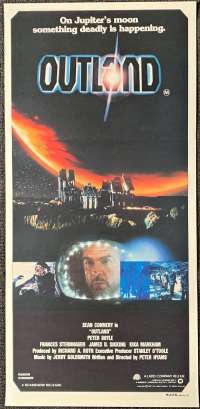
Daybill Poster. Outland is a 1981 British science fiction thriller film written and directed by Peter Hyams and starring Sean Connery, Peter Boyle, and Frances Sternhagen. Set on Jupiter's moon Io, it has been described as a space Western and bears thematic resemblances to the 1952 film High Noon. Principal photography took place starting with the miniature models in May 1980 and with the actors beginning in June 1980. Post-production for the film was completed in February 1981.Outland was pioneering as the first motion picture to use Introvision, a variation on front projection that allows foreground, mid-ground and background elements to be combined in the camera, as opposed to using optical processes such as bluescreen matting. This enabled characters to convincingly walk around miniature sets of the mining colony. The music to Outland was composed and conducted by veteran composer Jerry Goldsmith, who had previously worked with writer/director Peter Hyams on the science fiction thriller Capricorn One (1978) and had recently provided the soundtrack to Alien. The film was nominated for the Academy Award for Best Sound.
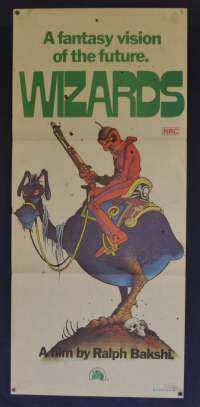
Poster artwork by William Stout.Wizards is a 1977 American animated post-apocalyptic science fantasy film about the battle between two wizards, one representing the forces of magic and one representing the forces of industrial technology. It was written, produced, and directed by Ralph Bakshi.Wizards is notable for being the first fantasy film made by Bakshi, who was previously known only for urban films such as Fritz the Cat, Heavy Traffic and Coonskin. It grossed $9 million theatrically from a $1.2 million budget, and has since become a cult classic.
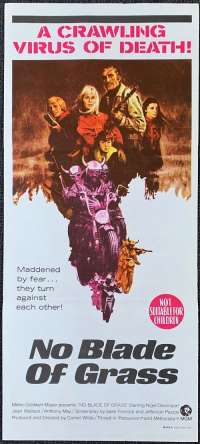
Daybill Poster.No Blade of Grass is a 1970 British-American apocalyptic science fiction film co-written, directed and produced by Cornel Wilde and starring Nigel Davenport, Jean Wallace, and John Hamill. It is an adaptation of John Christopher's novel The Death of Grass (1956) and follows the survivors of a plague that has hit London in the near future. When London is overwhelmed by food riots caused by a global famine, a man tries to lead his family to safety in Westmorland. The original cut of No Blade of Grass contained a graphic scene where a group of three biker men abduct and rape Ann Custance (played by Jean Wallace) and her 16 year old virgin daughter, Mary (played by Lynne Frederick). The intense graphic nature and sexual violence of the scene generated some mild controversy from critics who felt it was gratuitous. Compounding matters was that Lynne Frederick, who was one of the rape victims in the scene, was only 15 at the time and questions over the use of a body double remain a controversial topic to this day.
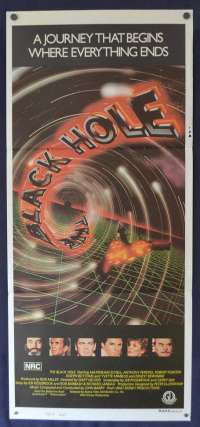
Daybill Poster.The Black Hole is a 1979 American space opera film directed by Gary Nelson and produced by Walt Disney Productions. The film stars Maximilian Schell, Robert Forster, Joseph Bottoms, Yvette Mimieux, Anthony Perkins, and Ernest Borgnine, while the voices of the main robot characters are provided by Roddy McDowall and Slim Pickens (both uncredited). The music for the film was composed by John Barry. It was the first film from Walt Disney Productions to receive a PG rating. At $20 million, plus another $6 million for the advertising budget, it was at the time the most expensive picture ever produced by Disney. The movie returned a gross profit of 10 million at the North American box office, making it the 21st highest-grossing film of 1979. The New York Times, Time and Variety Critics all praised the film. The visual effects were generally acclaimed by the press. The film received two Academy Award nominations for Best Visual Effects and Best Cinematography.
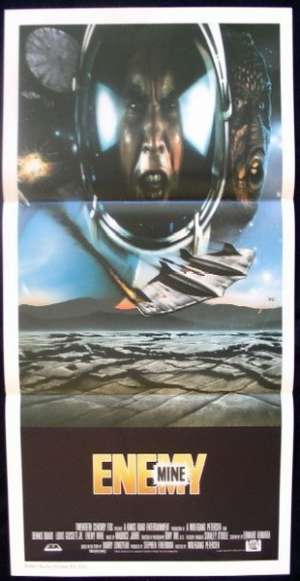
Daybill Poster.Enemy Mine is a 1985 West German-American dark science fiction drama film directed by Wolfgang Petersen and written by Edward Khmara, based on Barry B. Longyear's novella of the same name. The film stars Dennis Quaid and Louis Gossett, Jr. as a human and alien soldier, respectively, who become stranded together on an inhospitable planet and must overcome their mutual distrust in order to cooperate and survive. The film began production in Budapest in April 1984 under the direction of Richard Loncraine, who quickly ran into "creative differences" with producer Stephen Friedman and executives at 20th Century Fox; the project was shut down after a week of shooting. Petersen then took over as director and reshot Loncraine's scenes after moving the production to Munich. Upon release, The Los Angeles Times praised the film, calling it "surprisingly coherent, surprisingly enjoyable". The movie received similar praise from critics Gary Franklin, Gene Siskel, and Leonard Maltin. Big success was found in the former Soviet Union, where it became the first Western sci-fi film shown in the theatres. It gained a cult following afterwards in many other parts of the world.
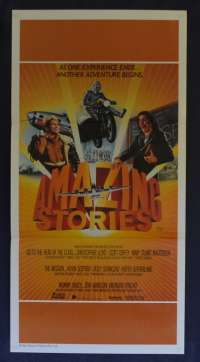
Amazing Stories is a fantasy, horror, and science fiction television anthology series created by Steven Spielberg. It originally ran on NBC in the United States from 1985 to 1987. Three of the episodes ("The Mission", "Mummy Daddy" and "Go to the Head of the Class") were packaged together as an anthology film and released theatrically in Australia (Sept 1987) and several European countries such as Spain, France and Finland. The series was nominated for 12 Emmy Awards and won five. The first season episode "The Amazing Falsworth" earned writer Mick Garris an Edgar Award for Best Episode in a TV Series. The series gained a number of positive reviews. The 1987 science fiction film Batteries Not Included was originally intended as a story for Amazing Stories, but Spielberg liked the idea so much that he decided to make it a theatrical release.
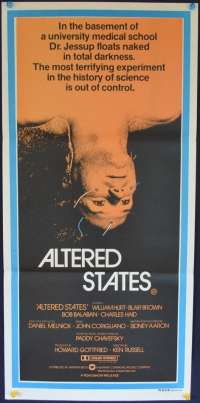
Daybill Poster.Altered States is a 1980 American science fiction-horror film adaptation of a novel by the same name by playwright and screenwriter Paddy Chayefsky. Altered States was Chayefsky's only novel and his final screenplay. Both the novel and the film are based on John C. Lilly's sensory deprivation research conducted in isolation tanks under the influence of psychoactive drugs like mescaline, ketamine and LSD. The film was directed by Ken Russell and was also the film debut of William Hurt and Drew Barrymore. Chayevsky was credited as a screenwriter for the film using the pseudonym Sidney Aaron, his actual first and middle names. The film score was composed by classical composer John Corigliano (with Christopher Keene conducting) and was nominated for an Academy Award. The film also received an Oscar nomination for Sound.
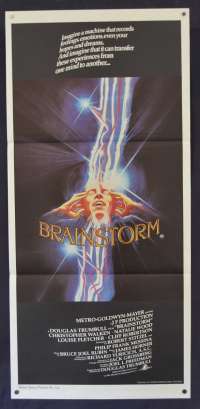
Brainstorm is a 1983 American science fiction film directed by Douglas Trumbull, and starring Christopher Walken, Natalie Wood (in her final film role), Louise Fletcher and Cliff Robertson.It follows a research team's efforts to perfect a system that directly records the sensory and emotional feelings of a subject, and the efforts by the company's management to exploit the device for military ends. To prepare for the film, Trumbull took most of the key cast and crew up to the Esalen Institute, an experimental research facility in Northern California known for its new-age classes and workshops. The film was nearly scuttled by Natalie Wood's death during a production break in November 1981. By this time, Wood had already completed all of her major scenes. MGM wanted to shut the film down until other studio’s started to show interest in bidding for the film from MGM. This interest persuaded MGM to continue with the making of the film and Natalie Wood’s younger sister was used in any remaining scenes. The film carries the dedication credit "To Natalie". Natalie Wood fans now consider this poster to be the final piece in their collection.
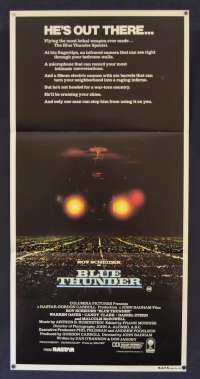
Original Daybill Poster.Blue Thunder is a 1983 action thriller film from Columbia Pictures, produced by Gordon Carroll, Phil Feldman, and Andrew Fogelson and directed by John Badham. The film features a high-tech helicopter of the same name and stars Roy Scheider, Warren Oates, Candy Clark, Daniel Stern, and Malcolm McDowell. Filmed on location in Los Angeles beginning in the early months of 1980, Blue Thunder was one of Warren Oates' last films before his death on April 3, 1982, which occurred during post-production, and the film is dedicated to him. Malcolm McDowell, who portrayed antagonist F. E. Cochrane, was intensely afraid of flying. John Badham recalled, "He was terrified. He used to get out and throw up after a flight”. Blue Thunder was a critical and commercial success. It was released on May 13, 1983. It was the #1 ranked film in the United States on its opening weekend, taking in $8,258,149 at 1,539 theaters, overtaking the previous #1 film Flashdance. The film was ranked #2 in its second and third weekends. Overall, in the US, it took in $42,313,354 for its 66 days of release.
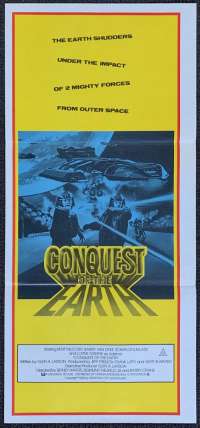
Daybill Poster - Conquest Of The Earth.The continuing saga of the Battlestar Galactica - The Battlestar Galactica and its rag-tag fleet of ships finally arrive at the Earth, only to discover that the planet is not prepared for the inevitable Cylon invasion. The feature was released in cinemas in Europe, New Zealand and Australia only. It was made up of a number of TV episodes from the TV series Battlestar Galactica 80.
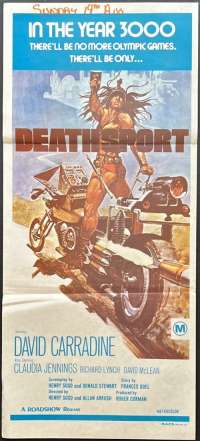
Daybill Poster. Deathsport is a 1978 science fiction B-film produced by Roger Corman, directed by Allan Arkush and Nicholas Niciphor. The film stars David Carradine and Playboy Playmate Claudia Jennings. It would also be one of Jennings' final movies before her death. The film was intended as a follow-up to Death Race 2000 (1975). The film was scored by Andy Stein and featured guitar riffs from Jerry Garcia.
| PO Box 491 Sherwood, 4075, Brisbane Queensland, Australia |
|
| 0419 736 441 | |
| MON - FRI - 9am to 5pm | |
| This email address is being protected from spambots. You need JavaScript enabled to view it. |