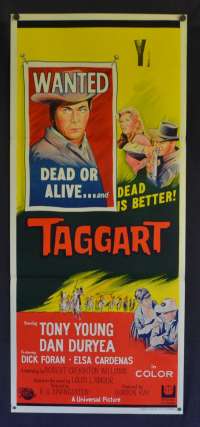
Hand Litho Daybill Poster.Taggart is a 1964 American Color Western film directed by R. G. Springsteen and starring Tony Young, Dan Duryea, Dick Foran, Elsa Cárdenas and Jean Hale. The storyline is: Kent Taggart's family has their cattle stampeded and murdered. In a fair gunfight Kent kills the man's son responsible for it all but runs, causing a warrant to be issued and a price to be put on his head. It was the film debut of David Carradine (Kung Fu TV Fame).
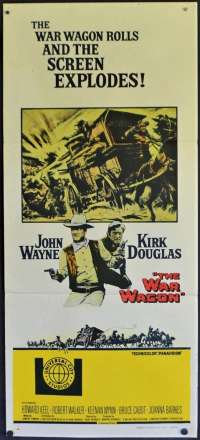
Daybill Poster.The War Wagon is a 1967 American Western film directed by Burt Kennedy and starring John Wayne and Kirk Douglas. Released by Universal Pictures, it was produced by Marvin Schwartz and adapted by Clair Huffaker from his own novel. The supporting cast includes Howard Keel, Robert Walker Jr., Keenan Wynn, Joanna Barnes and Bruce Dern. In June 1966 John Wayne announced he had signed a two picture deal with Universal, the movies being The War Wagon and The Green Berets. The film would be a co-production between Wayne's company, Batjac, and producer Marvin Schwartz. Filming started 19 September 1966 and went for 12 weeks. The film was shot in Durango, Mexico and Curubusco Studios in Mexico City. Director Burt Kennedy said he let Wayne direct himself during the movie. The picture received generally positive reviews and opened at number one at the domestic box office in 1967. It grossed $9,563,000 in total, making it a success.
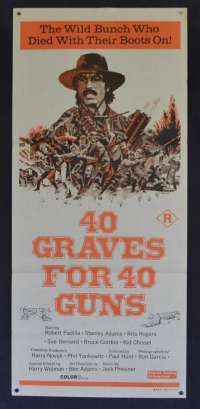
Daybill Poster.40 Graves For 40 Guns was released in 1971 and was directed by Paul Hunt.Starring: Robert Padilla, Gregory Sierra, Chuy Franco, Ron Castro, Stanley Adams and Bruce Gordon. This film was a fast paced and violent Mexico-set western. It chronicles the bloody struggle over a stolen gold cross. The murderous Harris gang started the trouble by stealing the icon from a Tecate church in a terrifying raid that left many townsfolk dead or brutalized. The head Federale assigned to bring the gang in realizes he is dealing with monsters and that to catch them he must fight fire with fire by enlisting the aid of the most notorious crook in prison with the promise of a pardon if the outlaw and his men are successful. When the two ruthless gangs finally clash, amidst considerable furor and treachery, unparalleled bloodshed and chaos ensues.
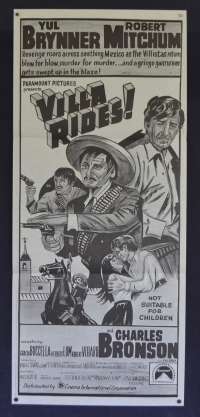
Villa Rides Duo tone Poster Art. Villa Rides is a 1968 American Technicolor western war film in Panavision directed by Buzz Kulik and starring Yul Brynner (in toupee) as Francisco Villa and Robert Mitchum as an American adventurer and pilot of fortune. The supporting cast includes Charles Bronson as Fierro, Herbert Lom as Huerta, and Alexander Knox as Madero. Sam Peckinpah wrote the original script and was set to direct but Brynner didn't like his depiction of Villa as cruel and had Robert Towne rewrite the script and sought another director. The screenplay is based on the biography by William Douglas Lansford. The storyline was as follows: Pulled into the Mexican Revolution by his own greed, Texas gunrunner and pilot Lee Arnold (Mitchum) joins bandit-turned-patriot Pancho Villa (Brynner) and his band of dedicated men in a march across Mexico battling the Colorados and stealing women's hearts as they go. However, each has a nemesis among his friends: Arnold is tormented by Fierro (Bronson), Villa's right-hand-man; and Villa must face possible betrayal by his own president's naiveté.
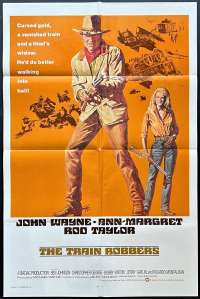
One Sheet Poster art of John Wayne by Robert Tanenbaum.The Train Robbers is a 1973 Western Technicolor film written and directed by Burt Kennedy and starring John Wayne, Ann-Margret, Rod Taylor, Ben Johnson and Ricardo Montalban. Filming took place in Sierra de Órganos National Park in the town of Sombrerete, Mexico. Critics said John Wayne's "legend not only lives in 'The Train Robbers,' it gleams.
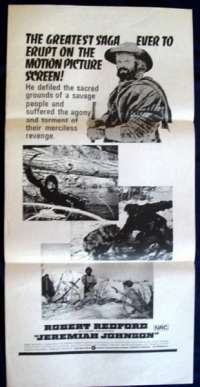
Daybill Poster art by Ted CoConis. Jeremiah Johnson is a 1972 American western film directed by Sydney Pollack and starring Robert Redford as the title character and Will Geer as "Bear Claw" Chris Lapp. The role of Jeremiah Johnson was originally intended for Lee Marvin and then Clint Eastwood, with Sam Peckinpah to direct. However, Peckinpah and Eastwood did not get along, so Peckinpah left and Eastwood decided to make Dirty Harry instead. Warner Bros. then stepped in and set up Milius' screenplay for Robert Redford. Without a director, Redford talked Sydney Pollack into it; the two were looking for another film to collaborate on after This Property Is Condemned. The film is said to have been based partly on the life of the legendary mountain man John Jeremiah Johnson, recounted in Raymond Thorp and Robert Bunker's book Crow Killer: The Saga of Liver-Eating Johnson and Vardis Fisher's Mountain Man. The film was shot at various locations in Redford's adopted home state of Utah. Struggling with weather and the budget, rarely were the crew able to shoot any second takes. Jeremiah Johnson had its world-wide premiere on May 7th at the 1972 Cannes Film Festival, where it was screened in competition. It was the first western film to ever be accepted in the festival. The film was a world- wide critical and commercial success.
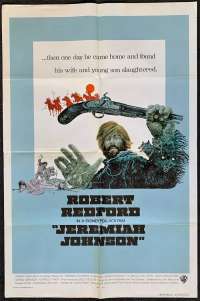
USA One Sheet Poster art by Ted CoConis. Jeremiah Johnson is a 1972 American western film directed by Sydney Pollack and starring Robert Redford as the title character and Will Geer as "Bear Claw" Chris Lapp. The role of Jeremiah Johnson was originally intended for Lee Marvin and then Clint Eastwood, with Sam Peckinpah to direct. However, Peckinpah and Eastwood did not get along, so Peckinpah left and Eastwood decided to make Dirty Harry instead. Warner Bros. then stepped in and set up Milius' screenplay for Robert Redford. Without a director, Redford talked Sydney Pollack into it; the two were looking for another film to collaborate on after This Property Is Condemned. The film is said to have been based partly on the life of the legendary mountain man John Jeremiah Johnson, recounted in Raymond Thorp and Robert Bunker's book Crow Killer: The Saga of Liver-Eating Johnson and Vardis Fisher's Mountain Man. The film was shot at various locations in Redford's adopted home state of Utah. Struggling with weather and the budget, rarely were the crew able to shoot any second takes. Jeremiah Johnson had its world-wide premiere on May 7th at the 1972 Cannes Film Festival, where it was screened in competition. It was the first western film to ever be accepted in the festival. The film was a world- wide critical and commercial success.
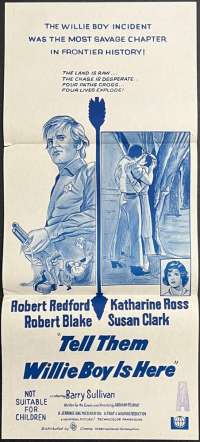
Duo Tone Daybill Poster artwork.Tell Them Willie Boy Is Here is a 1969 Technicolor Western film based on the true story of a Chemehuevi-Paiute Indian named Willie Boy and his run-in with the law in 1909 in Banning, California, United States. The film was written and directed by the once blacklisted Abraham Polonsky who due to his blacklisting, had not directed a film since Force of Evil in 1948. Source material for the film is Harry W. Lawton's 1960 book, Tell Them Willie Boy is Here. The film's story revolves around the Paiute Indian outlaw Willie Boy (Robert Blake), who escapes with his lover, Lola (Katharine Ross), after killing her father in self defense. According to tribal custom Willie can then claim Lola as his wife. According to the law, Deputy Sheriff Cooper (Robert Redford) is required to charge him with murder.
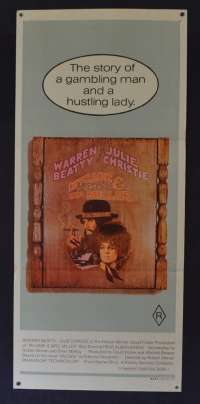
Richard Amsel Poster artwork.McCabe & Mrs. Miller is a 1971 American revisionist western film starring Warren Beatty and Julie Christie, and directed by Robert Altman. The screenplay is based on the 1959 novel McCabe by Edmund Naughton. Altman referred to it as an "anti-western film" because the film ignores or subverts a number of Western conventions. Altman offered the lead originally to Elliott Gould (he had just starred in Altman’s MASH) who turned it down to make I Love My Wife. The film was shot in West Vancouver and in Squamish, almost in sequential order, a rarity for film makers. The film was a critical and commercial success. Julie Christie's performance was nominated for the Academy Award for Best Actress.
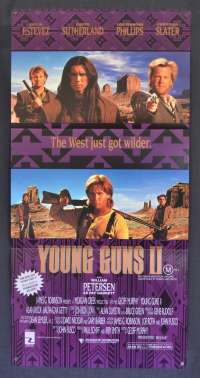
Daybill Poster.Young Guns II is a 1990 American western film and a sequel to Young Guns (1988). It stars Emilio Estevez, Kiefer Sutherland, Lou Diamond Phillips, Christian Slater, and features William Petersen as Pat Garrett. It was written and produced by John Fusco and directed by Geoff Murphy.It follows the life of Billy the Kid (played by Emilio Estevez), in the years following the Lincoln County War in which Billy was part of "The Regulators" – a group of around six highly skilled gunmen avenging the death of John Tunstall – and the years leading up to Billy's documented death. The film, however, is told by Brushy Bill Roberts, a man who in the 1940s appeared claiming to be the real Billy the Kid.While the film takes some creative license, it does show some of the main events leading up to Billy's documented death, including his talks with Governor Lew Wallace, his capture by friend-turned-foe Pat Garrett, his trial and his subsequent escape in which he killed two deputies.
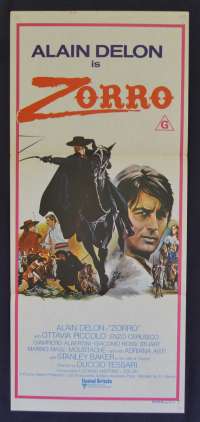
Daybill Poster.Zorro is a 1975 spaghetti Western film based on the character created by Johnston McCulley. Directed by Duccio Tessari, it stars French actor Alain Delon as Zorro as well as Stanley Baker. The movie, produced by an Italian studio, was filmed in Spain. The film was made in part because Alain Delon had enjoyed making the swashbuckler The Black Tulip in 1964 and wanted to do another one. Filming began in July 1974 in Spain, with most of the crew being from Italy. Some studio work was done in Rome. The final sword duel was inspired by Scaramouche (1952). Zorro was released in Italy on 6 March 1975.It was released in the United States on June 1976.
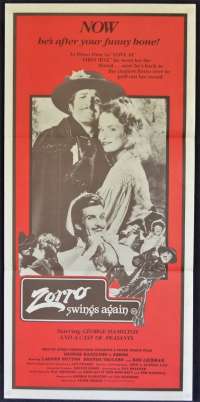
Daybill Poster.Zorro Swings Again Aka Zorro The Gay Blade is a 1981 swashbuckling comedy film directed by Peter Medak and starring George Hamilton, Lauren Hutton, Ron Leibman, and Brenda Vaccaro. The film was distributed by 20th Century Fox and produced by C.O. Erickson and Hamilton. Via its dedication to director Rouben Mamoulian and opening prologue, the film establishes that it is a sequel to 20th Century Fox's swashbuckling adventure film The Mark of Zorro (1940).Critics enjoyed the various performances and Hamilton was nominated for a Golden Globe award for playing the dual role of Don Diego de la Vega (Zorro) and his gay twin brother Bunny Wigglesworth, né Ramón de la Vega.
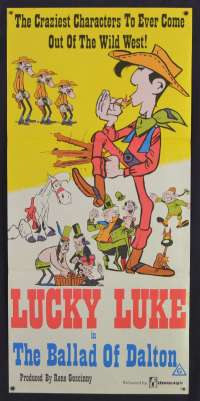
Lucky Luke is a 1991 Italian western comedy film directed by and starring Terence Hill and based on the Belgian comic book of the same name. It is also the pilot episode of the Lucky Luke television series. The storyline is: Lucky Luke becomes the sheriff of Daisy Town and runs out all the criminals. Then the Dalton brothers arrive and try to get the Indians to break the peace treaty and attack the town. Lucky Luke was shot in: Bonanza Creek Ranch and Santa Fe (New Mexico), Zia Pueblo, Valles Caldera National Preserve, White Sands National Monument and La Junta (Colorado), Tucson (Arizona). The opening theme of the movie is the song "Lucky Luke Rides Again", performed by Roger Miller. The main theme is the song "The Lonesomest Cowboy in the West", performed by Arlo Guthrie.
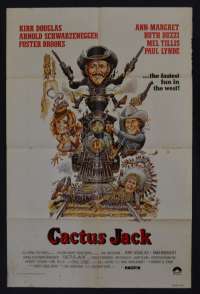
The Villain or Cactus Jack (It's title when released in the UK and in Australia) is a 1979 American film. A parody blend of western films and Warner Bros.' Wile E. Coyote cartoon situations, it was directed by Hal Needham and starred Kirk Douglas, Arnold Schwarzenegger, Ann-Margret, Paul Lynde, Foster Brooks, Strother Martin, Ruth Buzzi, Jack Elam, and Mel Tillis. Parts of the film were shot at Monument Valley in Utah where many Of John Wayne’s movies were filmed. Excellent Poster art by artist Jack Davis.
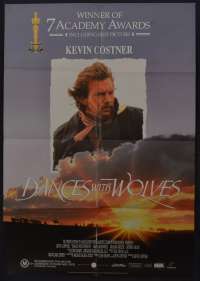
Dances With Wolves Poster One Sheet Original 1990.Dances With Wolves is a 1990 American epic Western film directed by, produced by, and starring Kevin Costner. It is a film adaptation of the 1988 book of the same name by Michael Blake. Costner developed the film with an initial budget of $15 million. Dances with Wolves had high production values and won seven Academy Awards including Best Picture and the Golden Globe Award for Best Motion Picture – Drama. The film is credited as a leading influence for the revitalisation of the Western genre of film making in Hollywood. In 2007, Dances with Wolves was selected for preservation in the United States National Film Registry by the Library of Congress as being "culturally, historically, or aesthetically significant"
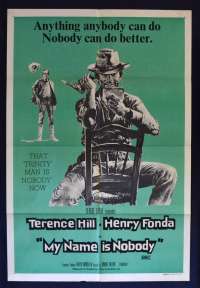
My Name Is Nobody Poster Original One Sheet 1973.My Name Is Nobody (Italian: Il mio nome è Nessuno) is a 1973 Spaghetti Western comedy film. The film was directed by Tonino Valerii and, in some scenes, by Sergio Leone. The film's title alludes to the reply Odysseus gave when Polyphemus the Cyclops asked his name. Shooting for My Name is Nobody started on April 30, 1973.It was one of the few films related to Sergio Leone where 80% of the outdoor scenes were actually shot in the United States. The film shot in nine weeks. Starring Henry Fonda and Terence Hill, the film grossed over 3.6 billion lire and was the third highest grossing film in Italy of the year.
| PO Box 491 Sherwood, 4075, Brisbane Queensland, Australia |
|
| 0419 736 441 | |
| MON - FRI - 9am to 5pm | |
| This email address is being protected from spambots. You need JavaScript enabled to view it. |